










Tens of billions of dollars are pouring into AI-driven drug discovery, but drug manufacturing timelines haven’t moved. Many of the most complex steps in biologics manufacturing, like cell and gene therapy production, are still done largely by hand, and a single contamination event can cost millions of dollars and delay treatment for patients. Multiply Labs, which calls itself a physical AI company, has raised funding to close that gap with robotics.
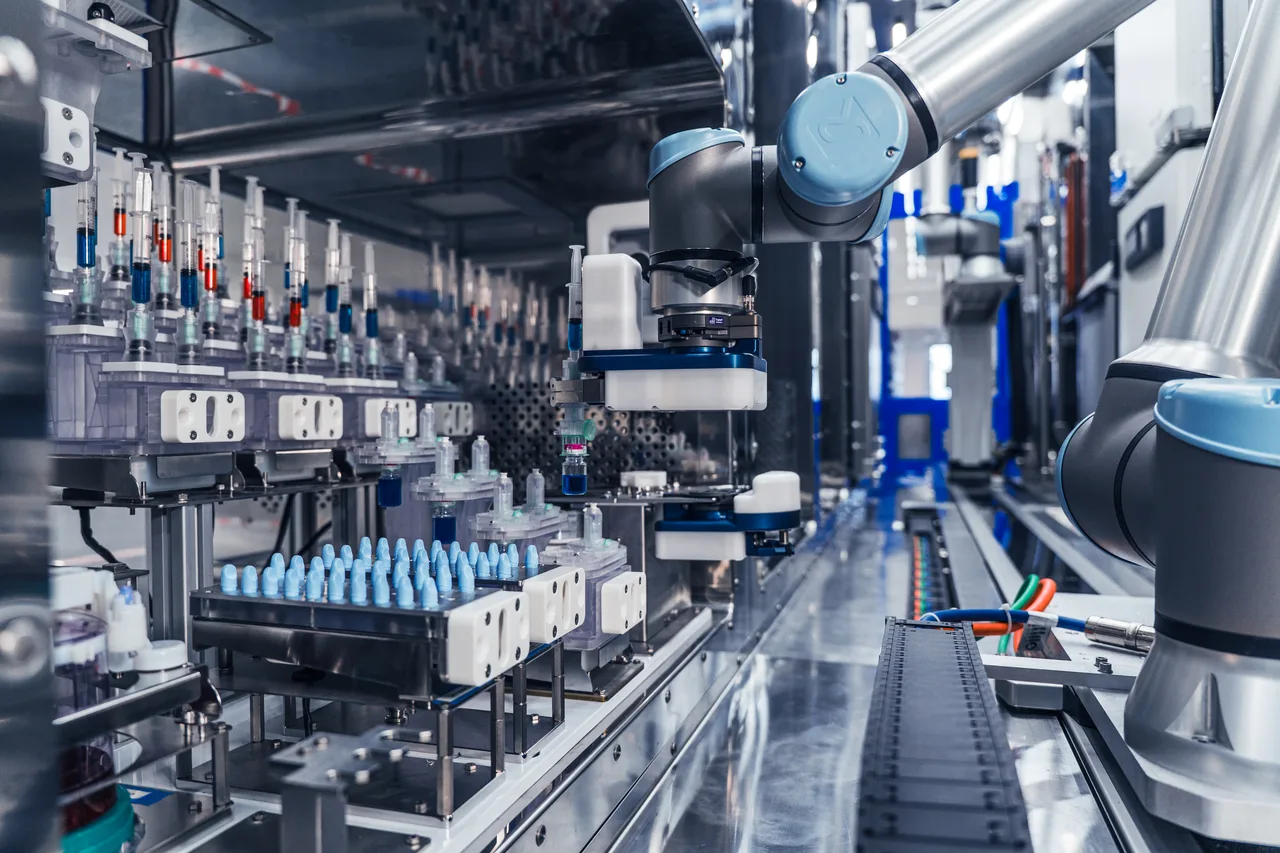
Multiply Labs’ robotic clusters integrate directly with a pharma company’s existing instruments and processes, so there’s no need for a new facility or changes to already-validated procedures. Inside an enclosed, GMP-compliant system, the clusters automate the timed, repetitive steps of biologics manufacturing, cutting the cost per dose by 74% and increasing throughput by up to 100x over manual production. The system is autonomous rather than merely automated — it learns, adapts, and runs continuously, eliminating the manual handoffs between process steps where contamination risk is highest. Multiply Labs started with cell and gene therapy and is now expanding into antibodies, viral vectors, and mRNA. Rather than running as an outsourced manufacturing service, each system is owned and operated directly by the pharmaceutical company itself, keeping production in-house.
Founder and CEO Fred Parietti holds a PhD in mechanical engineering from MIT and has done robotics research at Carnegie Mellon, Politecnico di Milano, and ETH Zurich. Co-founder Alice Melocchi, who holds a PhD in pharmaceutical technology from the University of Milan, met Parietti at MIT over a shared interest in robotics. The two built early prototypes in a Cambridge apartment before taking the company through Y Combinator and founding Multiply Labs in 2016.
Multiply Labs has raised $75 million in Series B funding, bringing its total capital raised to more than $100 million since founding. The round was led by Dr. Patrick Soon-Shiong with NantWorks, with new investors AstraZeneca, Lingotto, Teradyne, and Strange Ventures, and returning investors Casdin Capital, Lux Capital, Fifty Years, Ora Global, and Founders Fund. Its 2021 Series A ($20 million, led by Casdin Capital) had valued the company at $60 million post-money. “Robotics is the only way to deliver these therapies to patients at scale,” said Parietti. The new capital will fund manufacturing capacity, product development, and growth across engineering, regulatory, and commercial teams.
Automated cell and gene therapy manufacturing is already a crowded field. Cellares, which raised $257 million this past January, and Ori Biotech together account for more than 80% of capital raised in the category, and both hold the FDA’s Advanced Manufacturing Technology designation. In the UK, Cellular Origins, a spinout of engineering firm TTP, raised a $40 million Series A last year for its Constellation platform, which bolts robotics onto existing bioprocess instruments — that round was led by Johnson & Johnson Innovation, echoing the pattern of a major pharma backing a robotics-manufacturing startup directly, as Patrick Soon-Shiong is doing here. Unlike CDMO incumbents such as Lonza and Cytiva, Multiply Labs is differentiating by having pharma companies own and operate the equipment themselves.
MORE FROM THE POST
- Transfyr Launches With $25M Seed to Record the Science That Never Gets Written Down
- Marrow Therapeutics Launches With $173M Series A and B for Bone Marrow-Targeted Genetic Medicines
- Medical Robotics Startup MedInTech Raises USD 25.7M Series C to Expand AI Robotic Endoscopes Into Surgical Robots
- Mosaic Exits Stealth With $47M Seed to Build Surgical Robots That Navigate Blood Vessels
- Robot-by-the-Hour Startup Tutor Intelligence Raises $75M Series B
- AstraZeneca
- BioHealth
- biotech
- Casdin Capital
- Fifty Years
- Founders Fund
- funding
- Lingotto
- Lux Capital
- Multiply Labs
- NantWorks
- Ora Global
- Overseas funding
- Patrick Soon-Shiong
- physical ai
- robotics
- seriesB
- Strange Ventures
- Teradyne
Share

Most Read
- 1
- 2
- 3
- 4
- 5

Leave a Reply